São Bartolomeu da Serra Crackling Cake
São Bartolomeu da Serra crackling cake is made with bread dough, small pieces of crackling, cinnamon, lemon zest and a little sugar. Despite its name, it is shaped into individual buns and baked in a wood-fired oven. The contrast between the savoury seasoning of the crackling and the dough’s hint of sweetness makes it a lovely suggestion to share at the table on St Martin’s Day.
A recipe from São Bartolomeu da Serra
The Alentejo Gastronomic Inventory records this preparation in São Bartolomeu da Serra, in the municipality of Santiago do Cacém, in an interview with Maria Manuela Pereira in 2012. She learned it from her sister-in-law, who was from the same village. The collection presents it as a year-round recipe and notes that it was also made to sell at the São Bartolomeu festivities on 24 August, helping the residents’ association.
Estimated yield: 12 buns.
Preparation and shaping: about 25 minutes.
Rest after shaping: about 30 to 60 minutes.
Oven: about 20 to 30 minutes.
Initial cooling: about 15 minutes.
Estimated total time: 1 hour and 30 minutes to 2 hours and 10 minutes, not including heating the wood-fired oven and assuming you start with risen bread dough.
Ingredients
- 500 g risen wheat bread dough, uncooked, which you can ask for at the bakery
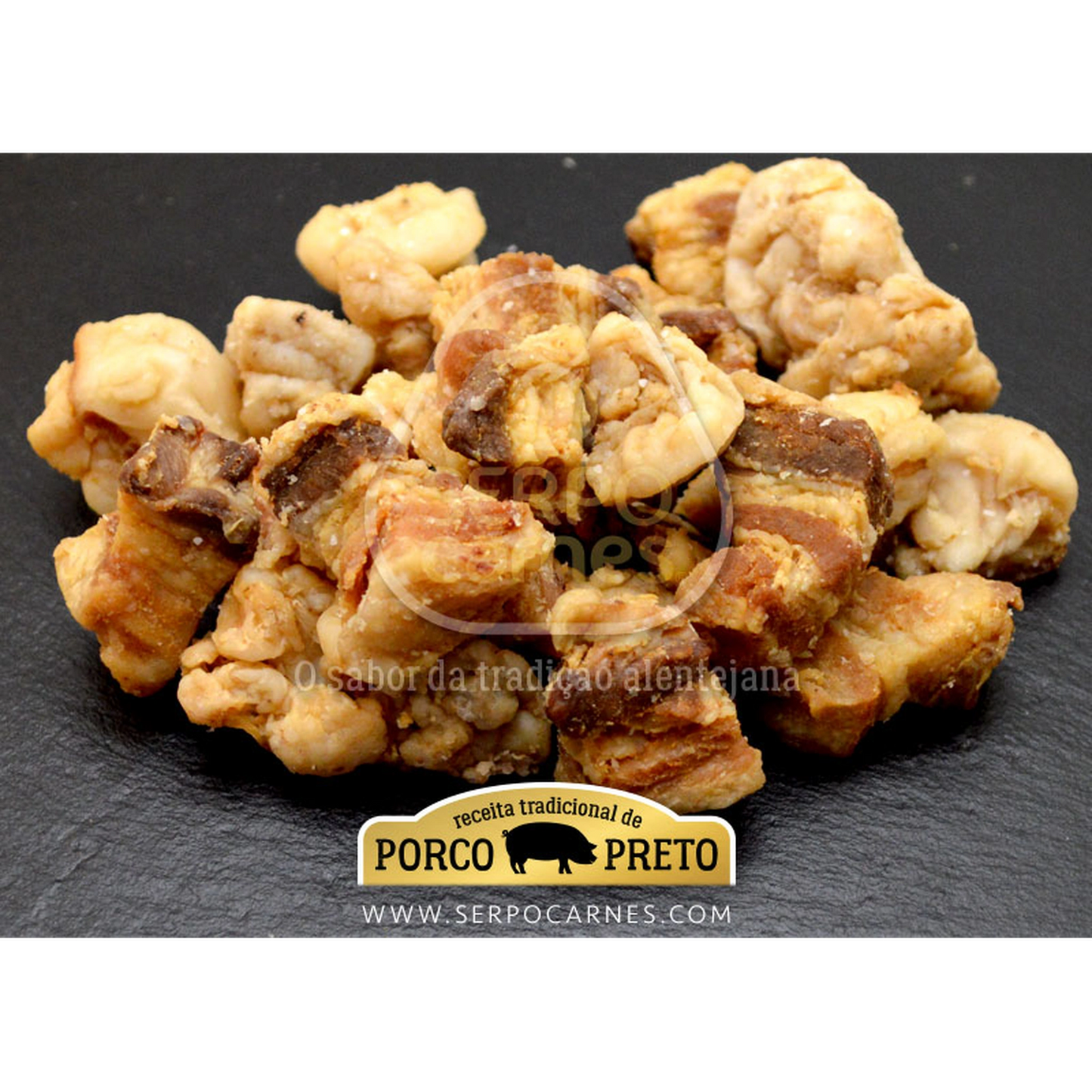
- 150 g Loose Black Pork Cracklings, cooked
- 40 g sugar
- 1 level teaspoon ground cinnamon
- Zest of 1 small lemon, yellow part only
- A little wheat flour for dusting the work surface and baking tray
Preparation
-
Prepare the oven and dough.
Heat the wood-fired oven in advance and let the temperature stabilise before baking. For this adaptation, aim for moderate heat, around 180 to 200 °C, measured with an oven thermometer where the baking tray will sit. Keep it away from the embers, with no direct flame over the buns. If the bread dough is refrigerated, leave it covered to come to room temperature while you prepare the remaining ingredients. -
Heat and chop the cracklings.
Put the pork cracklings in a frying pan and warm over low heat for about 2 to 3 minutes, just until the fat softens, without letting them brown any further. Remove from the heat, let cool slightly and chop into small pieces, about 3 to 5 mm. Reserve any small amount of fat they release as well. -
Knead in the flavourings.
Place the bread dough in a large bowl. Add the lukewarm pork cracklings, reserved fat, sugar, cinnamon and lemon zest. Knead for about 5 to 8 minutes, folding the dough over itself until the pieces and flavours are evenly distributed. If it sticks to your hands, pause briefly and fold it again; use only a light dusting of flour on the work surface to avoid drying out the dough. -
Shape and leave to rest.
Divide into 12 portions of about 58 g and shape into balls, pinching the seam closed underneath. Arrange them on a metal baking tray lightly dusted with flour, leaving about 4 cm between them. Cover with a cloth and leave to rest in a warm spot, away from direct oven heat, for approximately 30 to 60 minutes, until they are slightly larger and feel soft to the touch. The time depends on the bread dough used; they don't need to double in size. -
Bake in a wood-fired oven.
Bake the tray for about 20 to 30 minutes. Start checking after 15 minutes, and turn the tray if the heat is stronger on one side. The buns should be golden and firm, with fully baked bases. Once a bun has cooled slightly, cut it open to test: the crumb should be set, with no strip of raw, moist, sticky dough in the centre. If the surface browns before the crumb is baked, move the tray away from the hottest area and continue baking, checking at short intervals. -
Let cool slightly and serve.
Remove the buns from the baking tray and place them on a wire rack for about 15 minutes before cutting them open. Serve warm or let them cool completely. Cooling helps the crumb set without trapping steam underneath.
Tips for distributing the pork cracklings evenly
Finely chop the pork cracklings so you can incorporate them without tearing the dough. Warm them just until softened, then let them cool slightly: very hot fat can harm the yeast. When shaping, tuck any larger protruding pieces back into the dough so they don't burn in the oven.
Serve with talha wine
For this slightly sweet dough, with the flavor of the cracklings taking center stage, we recommend Vidigueira White Talha Wine DOC. It’s a pairing to serve the dough balls at the table, somewhere between a sweet treat and a savory snack.
Storage
Once cool, store leftovers in a sealed container in the refrigerator. To serve again, heat only the amount you need in the oven until the dough balls are hot all the way through. You can also freeze them once cool, separated into small portions.
Frequently asked questions
Can I use bread that has already been baked?
No. The recipe starts with unbaked bread dough. Ask your bakery for dough that has already risen; baked bread cannot be kneaded together with the cracklings.
The dough balls brown quickly but remain raw in the center. How can I adjust?
The heat is too high for this size of dough ball. Move the baking tray away from the hottest area, turn it if needed, and continue baking. For the next batch, let the oven cool down more before you start, and keep the portions a similar size.
More flavors of the Alentejo
For a variation on the technique, try the Borrachos from Póvoa de São Miguel, a thin dough made with white wine, fried in squares and finished with sugar and cinnamon.
Source and adaptations
Carta Gastronómica do Alentejo (2013), p. 1061, entry 0956, “Bolo de Torresmos,” São Bartolomeu da Serra, Santiago do Cacém. Interview with Maria Manuela Pereira by Inês Olaio Marques, ADL, in 2012.
Recipe collected in the Alentejo, adapted by Herdade do Estacal for the “À Mesa com o Alentejo” blog. The dough ingredients, heating and chopping of the cracklings, kneading, ball shape and wood-fired oven have been retained. The source does not provide quantities or timings. The quantities, pre-risen dough, flour for dusting, resting time after shaping, temperature range, and baking and storage instructions are part of this adaptation. Yield and timings are estimates.

Illustrative photo